How to Upload More Than 9gigs to Flash
You oft see 'The file is as well large for the destination file arrangement' error message when trying to copy a file larger than 4GB to a USB flash drive in Windows 10 or earlier versions.
E.g. if you lot try to copy a 5GB video file to an empty 16GB USB flash drive, the error message appears – even though at that place is plenty of free infinite bachelor on the USB drive.
[In older versions of Windows like XP you'd see a different mistake message stating 'There is non enough gratis disk space' which was even more unhelpful because it said there was not enough space on USB bulldoze when this was non the cause]
- Flash Drive Says Not Plenty Infinite But There Is
- What Are FAT32 and NTFS?
- FAT32
- NTFS
- How To Set up 'The File Is Besides Large For The Destination File Organisation' Error
- How To Convert USB Flash Drive to NTFS File Organisation
- Determination
Wink Bulldoze Says Not Enough Space Merely At that place Is
The cause of both error letters is zip to do with the amount of gratuitous storage space on the USB drive – in the case below I had 28GB complimentary space so a 10GB file would easily fit…

The mistake occurs because USB flash drives come up pre-formatted in the FAT32 file organization which has a maximum single file size limit of 4GB i.e. you tin can't re-create a file larger than 4GB into a FAT32 formatted drive, no matter how much free infinite is available.
So the error message is correct in saying that the file (4GB or more) is too big for the destination (USB bulldoze) file system (FAT32). Simply information technology'southward abrasive that Microsoft won't change the mistake message to clarify and tell y'all how to fix it!
What Are FAT32 and NTFS?
Fat (File Allocation Tabular array) is a type of file system and FAT32 is the latest version. It was ordinarily used on difficult drives in Windows computers before XP, which introduced a newer file system called NTFS – nonetheless used today by Windows 10.
Let's briefly compare the two file systems:
FAT32
Supported by almost all modern operating systems – so it is a good file organisation for sharing data between different computers like PC and Mac or other devices similar cameras and TVs.
Single file size limit – 4GB so FAT32 is all-time suited to relatively modest storage devices like USB flash drives and memory cards for phones/cameras.
NTFS
Improved operation, reliability and disk space use – so information technology is a bang-up file organization for larger capacity hard drives in modern Windows 10 computers.
Single file size limit – 16TB (c 16,000GB!) in W7, 256TB and higher in Windows viii/10. Realistically, that means information technology has no unmarried file size limit – y'all're never going to run across a 16,000 GB file ;-)
How To Fix 'The File Is Too Large For The Destination File Organization' Error
To exist able to copy a file larger than 4GB, y'all'll need to convert the USB drive from FAT32 to the NTFS file system.
Because NTFS realistically has no single file size limit, files of any size can then be copied to the USB drive.
[NTFS is the file system used past your PC hard bulldoze – that is why y'all don't see this error message when copying/saving files larger than 4GB inside your PC]
How To Convert USB Flash Drive to NTFS File System
i. Plug in your USB flash drive. For safety, have a fill-in of all files on it (e.g. re-create them to your reckoner) earlier proceeding to the adjacent step.
2. OPTIONAL – this stride enables write caching on the USB flash drive which optimizes it for quicker performance and is more suited to NTFS. You lot don't have to practise this stride – if you aren't too bothered nigh speed of data transfers skip to step 3:
- W7 or earlier – press Kickoff then right click 'Computer' and select 'Manage' to open the Computer Direction window.
- W8/10 – right click on the Commencement button then click on Computer Management to open the Computer Management window.
- In the left panel, choose Device Manager (nether System Tools).
- In the right console, double click 'Disk drives' to aggrandize the listing of devices – your USB drive should exist listed there:

- Right click your USB flash drive and choose 'Backdrop' to open up its Properties window and so select the Policies tab.
- Choose the 'Better Performance' (or 'Optimize for operation' in former versions of Windows) option then printing OK and close Calculator Direction:

Now you can alter the file organization on the bulldoze to NTFS in the adjacent footstep.
3. Convert The Drive To NTFS – in that location are two alternative ways to do this – the offset tries to keep all data on the USB bulldoze (no guarantees) only the second volition delete all data on the USB drive. Whichever method you cull, if you didn't accept a backup before, exercise it at present to avert information loss.
Method 1 – Conversion
- Click 'Outset' and type CMD into the search box. Right click on the 'CMD' program in the search results and select 'Run equally administrator'.
- You may now run across a User Account Control message asking "Do you want to allow the following program to make changes to this computer?". Click on 'Yes' to confirm.
- This will open up an elevated (Administrator) level Command Prompt window
- In the command prompt window, blazon
catechumen x: /fs:ntfsthen press Enter where ten: is the drive alphabetic character of your wink drive .
Eastward.g. in the case beneath, my USB wink drive is alphabetic character i: and so, to convert it to NTFS, I typed catechumen i: /fs:ntfs
- The process indicates when conversion is consummate:
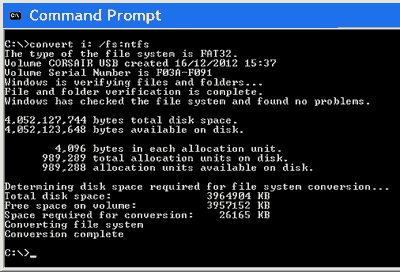
Note: if there was not enough free space on the Flash drive, the conversion will fail – either delete some data from it and try once more or skip to the next method which deletes all data on the drive.
- Shut the Command Prompt window. The drive is now using NTFS so you can transfer files larger than 4GB to it.
Method two – Format
This alternative method formats the USB drive which will definitely delete all information on it:
- Get to File Explorer (Computer)
- Right click your USB wink drive and select 'Format…'

- This opens the Format window as shown below. Change the 'File organisation' from FAT32 to NTFS.
- Tick 'Quick Format' to relieve time if you wish every bit the process can take a long time on a large capacity flash drive. All the same, if you leave it united nations-ticked then the format procedure will also exist able to scan for whatever damage to the drive:

- Press 'Starting time' to begin formatting the drive to NTFS and press OK to accept the alarm message that 'Formatting will erase ALL data on this deejay'
- After the procedure completes, a confirmation message appears
- Printing OK then Shut the Format window. The flash bulldoze is now using NTFS and then yous can transfer files larger than 4GB to it
four. Check the USB drive at present uses NTFS – if you desire to double cheque that the bulldoze does at present utilise NTFS, open File Explorer (Computer), correct click on your flash drive and select 'Backdrop' – the General tab should display 'File arrangement: NTFS' as shown below:

Conclusion
32GB+ wink drives are now common simply they however come up pre-formatted to the FAT32 file system for best compatibility with a wide range of computers and devices.
As we may now need to re-create ever larger files (eastward.g. videos) to flash drives, this mistake is becoming increasingly common. Even so, the limitation of the 4GB file size is easy to resolve past converting the flash drive'south file organization to NTFS.
Finally, if you lot have recently bought a new USB flash drive (specially from an auction site…) information technology is always worth testing information technology for errors or fake size – unscrupulous sellers offer cheap wink drives that are faulty or, for example, are sold as 32GB but are actually merely 4GB…
Source: https://techlogon.com/fix-the-not-enough-free-disk-space-error-on-usb-flash-drives/
0 Response to "How to Upload More Than 9gigs to Flash"
Post a Comment